What Delta Reign is, and what is actually confirmed
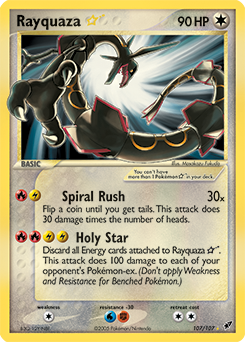
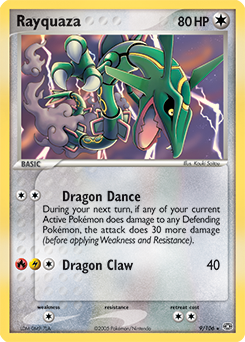
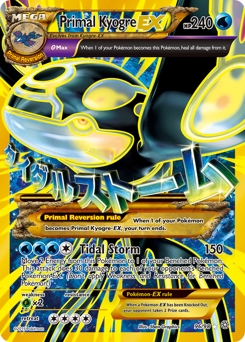
Pokémon TCG: Mega Evolution — Delta Reign is the sixth main expansion of the Mega Evolution era, and it releases on Friday, November 6, 2026. It is led by Mega Rayquaza ex. That sentence is very close to the sum total of what The Pokémon Company has officially said: the set was teased on June 18, 2026 with a name, a date and a single card, and as of today there is still no official expansion page for it on tcg.pokemon.com — the URL returns a 404. Everything else you will read about this set, on this page included, comes from Japan. The name is a double reference worth knowing, because it tells you what the set is about before a single card is revealed: the Japanese set is called Storm Emeralda, after Pokémon Emerald, the game that put Rayquaza on its box; the English name plays on Delta Stream, the Ability Mega Rayquaza has in the games. This is a Hoenn set with a dragon on the front, and Rayquaza has a long record of being the most expensive thing in whatever set it appears in.

Delta Reign and Storm Emeralda are the same set, but not the same size
Storm Emeralda released in Japan on July 31, 2026, and its card list has been fully public since. Delta Reign is its international counterpart, which is why a set three months away already has a card list circulating with images and prices attached. Two things are worth being precise about before you treat that list as gospel. First, English releases are not straight translations — the international set usually merges the Japanese main set with cards from smaller Japanese products, and the counts move. Take the previous pair: Japan’s Abyss Eye was 118 cards, 81 in the main set plus 37 secret rares. It arrived in English as Pitch Black at 120 cards, 84 printed plus 36 secret rares. The printed set grew by three and the secret rares shrank by one. So if Storm Emeralda is 113 cards — 76 main plus 37 secret rares, which is confirmed on the Japanese side — the honest English projection is somewhere around 113 to 118, not 113 exactly. Second, the fourteen-week gap here is longer than this era’s norm because 30th Celebration took the September slot. Abyss Eye reached English in eight weeks. Nothing has gone wrong; the anniversary set simply got in the way.
Confirmed, inferred, and unknown
Almost every page covering this set blurs these three categories together. Here is where the line actually sits today:
- Officially confirmed for English — the name Mega Evolution — Delta Reign, the November 6, 2026 release date, and one card: Mega Rayquaza ex.
- Known from Japan only — the 113-card Storm Emeralda pool, the four Mega ex cards, the three split Stadium cards, the secret-rare breakdown, and every card name and number you have seen quoted.
- Not confirmed anywhere — the English card count, the product lineup, MSRP, booster box configuration, Elite Trainer Box contents, and whether a Pokémon Center exclusive ETB exists for this set.
- Not knowable — pull rates. The Pokémon Company has never published them for any set, and anyone quoting official Delta Reign odds is quoting something that does not exist.
What’s in the set, as far as Japan tells us
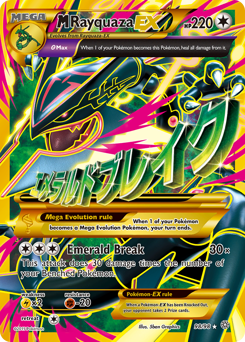
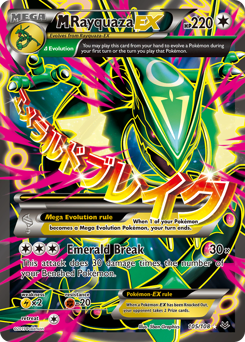
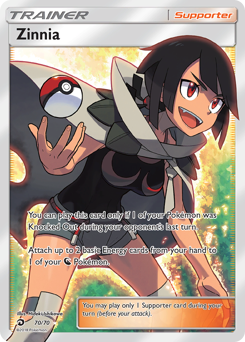
Flagged clearly: none of this is confirmed for English yet, and card names in particular are working translations that TPCi will re-letter. On the Japanese side, Storm Emeralda carries four Mega Evolution ex cards — Mega Rayquaza ex, Mega Golisopod ex, Mega Golurk ex and Mega Malamar ex — plus a run of ordinary ex cards including Raikou ex, Talonflame ex, Wishiwashi ex and Heat Rotom ex. The Trainer slate is Hoenn through and through: Zinnia, Aarune, and Tate & Liza all get Supporters, alongside a returning Pokémon Catcher. There are three new special Energy cards. The secret-rare layer breaks down as 12 Art Rares, 18 Super Rares, 6 Special Art Rares and one Mega Ultra Rare, and that last one is a single card: Mega Rayquaza ex, numbered 113/076. Kyogre and Groudon both appear in the Art Rare run, which is the sort of detail that makes a Hoenn set feel like a Hoenn set rather than a Rayquaza set with extras.
The split Stadium cards are the genuinely new thing
This is the mechanic worth understanding, and it is the first of its kind in the game’s history. Storm Emeralda contains three Stadium cards that are each printed as two separate cards — a left half and a right half — and the printed rule says you cannot play either one alone. You combine both halves from your hand and put them into play as a single Stadium. The three are Legendary Trench (071 and 072), Legendary Summit (073 and 074) and Legendary Lava Cave (075 and 076) — those are working translations of the Japanese names, and only Legendary Summit is rendered the same way by every source, so expect at least one of the other two to be lettered differently in English. All six halves sit at Uncommon in the main set with no secret-rare versions. The collector hook is that each pair’s artwork is one continuous illustration split across two cards — the first time the TCG has printed a Stadium as a panorama. The obvious comparison is the LEGEND cards from HeartGold & SoulSilver, which also demanded two halves, and the comparison is fair as far as the ritual goes. Mechanically it is a real cost, not a gimmick: needing two specific cards in hand at once to play one Stadium is a consistency tax that will keep some of these out of decks that would otherwise want them. The effects, transcribed from the Japanese cards, are Legendary Trench doubling all HP recovery for both players, Legendary Summit making the opponent take one fewer Prize when a Colorless Pokémon is knocked out, and Legendary Lava Cave stripping Abilities from every evolved Pokémon in play on both sides. That last one is the closest thing the format has seen to Path to the Peak since it rotated, and the middle one is a Prize-denial effect aimed squarely at a Colorless Mega Rayquaza.
Which cards to chase, and what Japan’s prices already say
The top of the set is not in question: Mega Rayquaza ex exists as a Special Art Rare (110/076) and as the set’s only Mega Ultra Rare (113/076), and the Mega Ultra Rare is the chase. The Special Art Rare has a story attached that is worth more than the artwork description we are not going to give you from a screenshot — it is illustrated by Kazuki Minami, one of the winners of the 2024 Pokémon TCG Illustration Contest, and it is only the second card he has drawn for the game. Our database holds 20,479 cards across 174 sets and his name appears on none of them. Below the Rayquazas, the Mega Golisopod ex Special Art Rare and the Zinnia’s Trust Special Art Rare lead the next tier. Now the useful part, and the part most pages covering this set will not tell you: Japan has been pricing these cards for over two weeks and the numbers are unstable enough that quoting one is misleading. Reports of the Mega Ultra Rare’s opening price range from about ¥298,000 to ¥348,000, and asks a fortnight later are being reported anywhere from ¥170,000 to ¥350,000 depending on whether you are reading shop quotes or marketplace asks. That is roughly $1,100 to $2,300 for the same card on the same week. What is consistent across sources is direction: the mid-tier Special Art Rares have softened hard — the Mega Rayquaza SAR roughly halved in week one — while the single Mega Ultra Rare has held up best. Treat all of it as a signal about shape, not a price, and remember English prices do not exist until English packs open in November.
Preorders: what exists, and what it costs
Preorder listings for Delta Reign booster boxes, Elite Trainer Boxes and bundles are already live at hobby retailers. Every one of them is retailer-sourced. The Pokémon Company has not published a product lineup, an MSRP, or a booster box configuration for this set, so a listing describing a 36-pack box or a nine-pack Elite Trainer Box is describing the previous set’s format and assuming it repeats — which is a reasonable assumption and still an assumption. On price: early hobby-shop preorders have been quoted around $200 for a 36-pack box. For comparison, the Pitch Black booster box, the same product one set earlier, lists at $161.64. Paying a quarter over the previous set’s list price for a box whose contents have not been officially announced is a choice you should make deliberately rather than by default. Two more things worth knowing before you commit. Do not confuse a Japanese Storm Emeralda box with an English Delta Reign box — the Japanese box is 30 packs of five cards at a ¥6,000 list, the English box is expected to be 36 packs of ten cards plus an Energy and a code card, so they are not comparable objects at any price. And November 6 sits three weeks before Black Friday, which historically is when sealed product from a just-released set is least likely to be discounted and most likely to be marked up. If your instinct is to wait, the January window after the launch rush is usually kinder.
The Delta Reign binder plan
You can do the math now and buy pages before the rush, which is most of the value of reading about a set in August. If the English release lands near the Japanese 113, the complete master set runs to thirteen 9-pocket pages — twelve full, four cards on the thirteenth — so a standard 360-pocket zip binder holds it four times over and a 180-pocket binder is the sensible size. Set-number order is the right sort here for the same reason it was right for Pitch Black: it keeps the printed set and the secret rares as two separate runs. The pleasing bit of arithmetic is in the chase layer. The 12 Art Rares and 6 Special Art Rares come to exactly 18 cards — two facing 9-pocket pages, no gaps — and the single Mega Ultra Rare is the one card that does not fit, which is arguably the correct place for it. Give it a page or a toploader of its own. Add three pages of pocket capacity to whatever you plan if the English set grows the way Pitch Black grew over Abyss Eye.
Where the split Stadiums go
This is the one page in this set you have to plan rather than fill, and it is a small trap. The six Stadium halves are three panoramas, and a panorama only works if both halves sit side by side in the same row — split a pair across a row break and you have two random landscape fragments. On a 9-pocket page the clean solution is to put each pair in the first two pockets of its own row: pockets 1 and 2, 4 and 5, 7 and 8. All three panoramas read correctly on one page, and the third column is left over for the set’s three non-Rayquaza Megas, which is a tidier page than anything set order would give you. If you would rather not leave a column doing decorative work, a 4-pocket page holds two halves per row exactly, so a pair fills a row with nothing wasted. Sleeve them before you sort — these are Uncommons, they will arrive bent from a pack, and a panorama shows a warped card far more obviously than a solo card does.
The Delta Reign pack trick, in advance
If you have searched for a Delta Reign pack trick or card trick, you are looking for the opening method that puts your hit last, and it will work on this set for the same reason it works on every recent one: Scarlet & Violet-era packs, which the Mega Evolution sets follow, come stacked in a fixed order. The pack runs commons first, then uncommons, then the reverse holos, then the holo or rare, with a basic Energy and the code card at the very back. The trick is to peel the code card off the back, move the Energy card to the front, and thumb through front to back — the last card you flip to is your rare, ultra rare or Art Rare, and the one before it is a reverse holo. That is it, one card moved. Older eras took more work: Sun & Moon through Crown Zenith needed the back four cards moved, and sets before that needed three. The honest caveat is the same one it has always been. This tells you the order inside a pack you have already bought and paid for. It cannot identify a winning sealed pack on a shelf, and it does not change the pull rates by a fraction. Note also that the Japanese Storm Emeralda packs are five cards rather than ten, so the ordering advice you see in Japanese opening videos does not transfer card-for-card.
What happens on this page between now and November
Delta Reign does not have a set page on NinePocket yet, and it will not have one until there is an English card list with English numbering to hang it on — a card list built from translated Japanese numbering would be wrong in ways that are annoying to unpick later. When the English set data lands, the full card gallery, per-card prices, the most-valuable ranking and the free printables — dividers, a master-set checklist and placeholder cards for the holes — go up the same way they did for Pitch Black. In the meantime, the release-dates hub tracks the confirmed calendar and this page gets updated as the official reveals arrive. If you want to hold these cards before November, the Japanese Storm Emeralda printing is out now and is the same cards in a different language; whether that is worth doing depends entirely on whether you collect by artwork or by set.