Sort into three piles before you buy anything
Storage stops being complicated the moment you stop treating a collection as one thing. The expensive mistake runs in both directions — buying toploaders for commons, or leaving a $200 card loose in the same box as the bulk. Almost every card you own falls into one of three piles, each wanting a different container, so decide which pile a card is in as it comes out of the pack and the rest of this page mostly answers itself:
- Bulk: commons, uncommons, energies and duplicates — the four hundred cards left over after you pulled the six you cared about. Bulk wants a cardboard box and nothing more.
- Binder-worthy: cards you would actually take off a shelf to look at, plus any set you are completing. That wants pages.
- Small and expensive: singles worth enough that a bent corner costs real money, plus sealed product. That wants rigid holders and a shelf out of the sun.

Cardboard storage boxes: the default, and the size to buy
For bulk this is the answer and there is no close second. A plain corrugated card box costs a couple of dollars, holds cards standing upright on their long edge exactly the way they should be stored, and takes dividers so you can find things again. BCW sells them in a ladder — 100, 200, 300, 330, 400, 500, 550, 660, 800 and upward to 3,200 — and the count printed on the label is the one thing worth reading carefully, because it is a rating rather than a promise. Those numbers assume loose, unsleeved cards, and thicker sports cards at that. BCW's own large bins are rated for 1,600 loose sports cards or 2,200 TCG cards in the identical volume, which tells you how much tighter Pokémon cards pack than the label implies — and sleeving pushes it back the other way. The practical rule is to buy one size up from what the arithmetic says and leave the last couple of inches empty, because a box packed to the walls is a box where cards get bent going in and out. Two habits matter more than which brand you buy: cards stand upright on their edge rather than stacked flat where the weight of the pile presses on the bottom card, and the box lives on a shelf rather than on the floor.
What a cardboard box is not
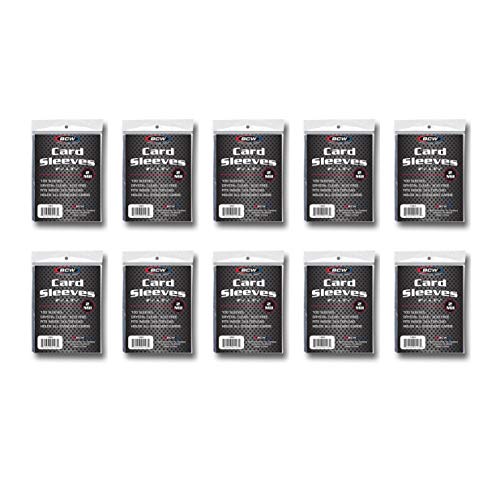
It is not an archival enclosure, and nobody selling them claims otherwise. Plain corrugated cardboard is not acid-free unless the box specifically says so, and the cheap ones do not. That is genuinely fine, because in a correctly built setup the sleeve is the chemical barrier and the box is only there to stop dust, light and knocks. It stops being fine the moment unsleeved cards go straight into one, which is also the moment the box starts costing you more than it saves. Penny sleeves work out to well under a cent each in bulk. There is no collection large enough for that to be the corner worth cutting.
Plastic and waterproof boxes: read the plastic
Plastic solves two things cardboard does not — water, and stacking under real weight — and it introduces one problem of its own. The material is the part to check, and it is not a detail. Polyvinyl chloride is the plastic to avoid outright: it carries plasticizers that migrate out over years, and conservators treat it as actively harmful rather than merely cheap. The Library of Congress names polyethylene, polypropylene and polyester (PET) as stable and inert for storage and says to avoid PVC and unknown plastics, and it warns off coated or hazy-surfaced plastic, since haze usually means a coating or a heavy plasticizer. In practice a polypropylene box from a card supplier is fine and a mystery bin from a discount store is a bet you are placing with everything sealed inside it, because a degrading PVC item off-gasses onto its neighbours. The problem plastic introduces is that sealing is not free: an airtight box preserves whatever humidity was in the room when you closed it, and a sealed damp box is how mould starts. Drop a silica packet in each one and open them occasionally.
Binders: for the cards you actually want to look at
A binder is a display solution that happens to store, and keeping that straight saves real money. Per card held, a binder costs several times what a box costs, so it earns its place only for cards you will open the binder to see — a set you are completing, a themed page, your best pulls. Filing bulk into binders is the single most common way collectors overspend on storage. We cover the rest of it properly elsewhere rather than repeating it here: which binder to buy, whether binders are safe for cards at all, side-loading versus top-loading pages, and how to organise what goes inside one. Three details carry most of the weight. Side-loading pockets, so gravity cannot slide a card out of an upright binder. D-rings rather than round O-rings, so the rings sit clear of the pages instead of pressing into them. And PVC-free pages, for the same reason as the boxes above. One storage rule specific to binders: they stand on their spine like books. A stack of binders lying flat puts the weight of the whole pile through the pages onto the cards at the bottom.
Drawers and cabinets, once boxes stop scaling
Somewhere north of ten thousand cards a wall of identical white boxes stops being a system, because finding anything means lifting five boxes off a shelf to reach the sixth. Two things fix that. The first is a purpose-built card catalog — a multi-drawer unit where each drawer is a row you pull out and flick through without unstacking anything; BCW makes six-drawer versions, including one sized for graded slabs. The second is the large plastic card bin, which is a drawer in spirit: rated at 1,600 or 3,200 loose sports cards (2,200 and 4,400 TCG cards respectively), stackable with sliding lid locks, with rows that also take partitions, magnetics, toploaders and deck boxes. General office or craft furniture works too and is usually cheaper — a shallow-drawer unit holds cards perfectly well — with one caveat worth taking seriously. Check what the drawer is made of and how recently it was finished. Fresh wood finishes and particleboard off-gas, and a closed drawer concentrates whatever they emit rather than dispersing it. Let anything new air out for a few weeks before cards go in, and keep the cards sleeved.
3D-printed storage: excellent trays, not an archival enclosure
The demand here is real and the designs are genuinely good, so this deserves a straight answer rather than a shrug. The free model sites are full of trading-card sorting trays built for exactly this job — stackable, printed to card width, the better ones offering both a sleeved size fitting cards up to about 72mm wide and an unsleeved size around 66mm, in heights holding roughly fifteen, thirty or forty cards, usually with a spot for a label. For sorting bulk, breaking down a collection, or laying a set out in order before it goes into a binder, a printed tray beats anything you can buy, because you can print exactly as many as the job needs and adjust the dimensions to your own sleeves. Deck boxes, dividers and display stands print just as well.
The two honest cautions on printed storage
Neither is a reason not to print, and both are worth knowing before you design around it. The first is heat. Standard PLA has a glass transition temperature around 55 to 60°C and a heat deflection temperature lower still, which in plain terms means a PLA tray left in a car or on a sunny windowsill will sag — a car interior in summer reaches roughly 70°C. PETG is the usual answer if the part has to survive heat, with a glass transition around 80 to 85°C. The second caution is the archival question, and the honest answer is that nobody has established one. PLA is a polyester and is widely treated as inert as a base resin, but no conservation body lists 3D-printed PLA among the plastics approved for long-term storage the way they list polyethylene, polypropylene and PET, and a spool of filament is base resin plus colorants and additives that vary by brand and are not disclosed to you. Printed parts also carry layer lines, which hold dust and are not a smooth surface to press against a card face. So the sensible position is the practical one: print trays, sorters, dividers and stands and use them daily, keep the cards sleeved inside them, and do not make a printed part the thing a valuable card sits pressed against for the next ten years. A penny sleeve and a known plastic cost almost nothing and have a track record.
Toploaders and semi-rigids, for the singles that earn it
Rigid protection is a per-card decision, not a storage system, and the threshold is roughly the point where a bent corner would genuinely annoy you — call it five to ten dollars and up. A penny sleeve goes on first, every time, because a bare card dropped into a toploader rubs against hard plastic. Semi-rigid card savers are a different tool for a different job: they are what grading submissions travel in, since PSA and the other graders want semi-rigid holders rather than rigid toploaders. The storage-specific point people miss is that toploaders do not file like cards do. They are thicker, they do not flex, and a drawer of loose ones sliding against each other is worse for the cards inside than the box of sleeved singles beside it. Give them their own home — a toploader binder, a bin row sized for them, or a dedicated box — rather than mixing them into the bulk. Our protection guide covers the full stack tier by tier.
What not to do, and why
Rubber bands, first and worst. The Library of Congress lists rubber bands alongside tape and paper clips among the fasteners to keep away from collections, and the reason is visible within a year: a band around a stack leaves a permanent indentation across every card it touches, then perishes into something sticky. Second, attics, garages and basements — and this one is not a matter of degree. Conservation guidance is blunt that none of the three is a suitable place for anything of value, because none has controlled temperature or humidity and all three carry a raised risk of leaks and flooding. Sealing the cards in a plastic bin first does not rescue it; the Library of Congress specifically notes that a plastic container in a high-humidity space increases mould risk rather than reducing it. Heat curls cards, humidity swings curl them repeatedly until the curl sets, and foil cards go first. Third, stacking flat: boxes stack, binders do not, and cards inside a box stand on edge rather than lying in a pile. Fourth, direct sunlight, which fades artwork through glass and through clear plastic alike — no ordinary container is UV-rated unless it says so. And fifth, storing anything unsleeved, which undoes most of the rest of this page.
A system that fits your collection size
Under a thousand cards: one 800-count box for bulk, a bulk pack of penny sleeves, a set of dividers, and one good binder for the cards you like. That is under fifty dollars and it is genuinely all you need — most collectors buy their second binder long before they need it. One to five thousand: several boxes labelled by set or by type, dividers inside each, and the binder reserved strictly for cards that earn a pocket. Five to twenty thousand: this is where the plastic bins start paying for themselves, along with printed or bought sorting trays for the incoming pile, a second binder for chase cards, and toploaders for the top twenty or so singles. Above twenty thousand, the constraint stops being protection and becomes retrieval — the question is no longer whether a card is safe but whether you can find it in under a minute — and that is the point where a drawer catalog or a labelled bin wall is worth the money, ideally alongside a spreadsheet or an app that tells you which container to open.
The part that matters more than the container
Every specific product above matters less than three habits: sleeve the card, stand it on its edge, and keep it somewhere with stable temperature and humidity and no direct sun — which in most homes means an interior shelf in a room you actually live in. A collection in cheap cardboard boxes on a bedroom shelf will outlast the same collection in expensive cases in a garage, and it is not close. Storage is mostly a question of where the box is rather than what the box is made of, which is convenient, because where the box is happens to be the free part.