What the suffixes actually mean
ex, GX, V and the rest all mark special, more powerful Pokémon — bigger HP, stronger attacks, and a boxed rule printed at the bottom of the card that collectors call a Rule Box. The trade-off is built into the game: when one of these Pokémon is Knocked Out, your opponent takes extra Prize cards instead of just one, so playing them is a bet rather than a free upgrade. More importantly for collectors, these are the cards that get the premium treatment — full arts, alternate arts, textured golds — so the suffix is usually your first clue that a card is worth looking at properly. The single most useful thing to understand is that each suffix belongs to a specific span of years. The letters are not power grades that coexist; they are era stamps, and knowing which era a suffix belongs to lets you date almost any modern card at a glance.
The complete era timeline
Read this top to bottom and you have the whole vocabulary. Each mechanic was the flagship of its block, was discontinued when the next block arrived, and is now only found in cards printed during its run:
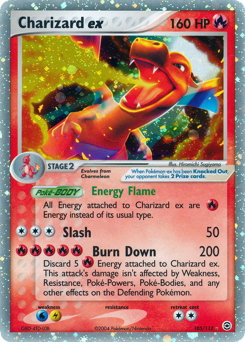
- Pokémon ex (lowercase) — 2003 to 2007, the original EX era. Two-Prize Basic Pokémon; the first time the game printed a card that cost you extra when it fell.
- Pokémon LV.X — Diamond & Pearl era, 2007 to 2009. Played on top of a Pokémon already in play rather than evolved onto it, and worth one Prize.
- Pokémon Prime and Pokémon LEGEND — HeartGold & SoulSilver era, 2010 to 2011. Primes are single one-Prize cards with a distinctive foil treatment; LEGEND cards come in two halves that must both be in play to form one Pokémon, and give up two Prizes.
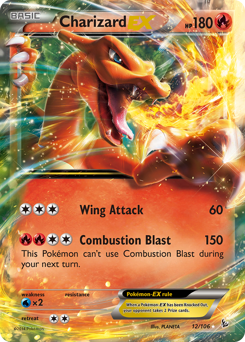
- Pokémon-EX (uppercase, hyphenated) — 2012 to 2016, across Black & White and XY. Two Prizes, and the revival of the mechanic under a deliberately different name.
- M Pokémon-EX (Mega) — XY era, 2014 to 2016. Evolve from a Basic Pokémon-EX of the same species, and playing one immediately ends your turn unless the matching Spirit Link Tool is attached. Two Prizes.
- Pokémon BREAK — XY era, 2015 to 2016. Stacked sideways on the Pokémon below, keeping its attacks and Abilities. One Prize.
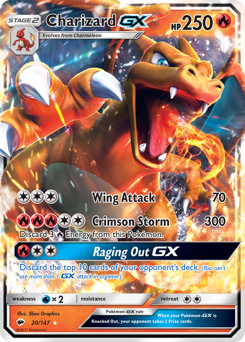
- Pokémon-GX — Sun & Moon era, 2016 to 2019. Two Prizes, plus a single GX attack usable once per game. Tag Team GX cards put two Pokémon on one card and give up three Prizes.
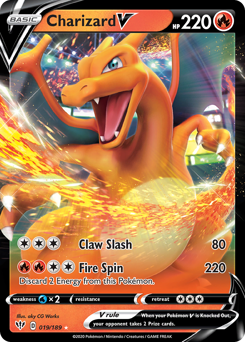
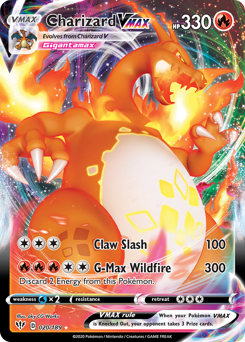
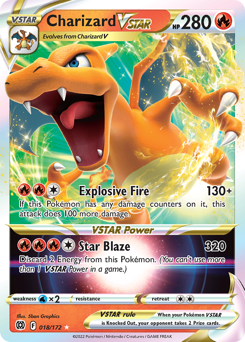
- Pokémon V, VMAX and VSTAR — Sword & Shield era, 2019 to 2022. V are the two-Prize baseline, VMAX evolve from a V into a giant Dynamax form and give up three Prizes, and VSTAR evolve from a V, give up two Prizes and add a once-per-game VSTAR Power.
- Radiant Pokémon — Sword & Shield era, 2022. Shiny one-Prize Basics with a hard limit of one per deck, and no Rule Box penalty at all.
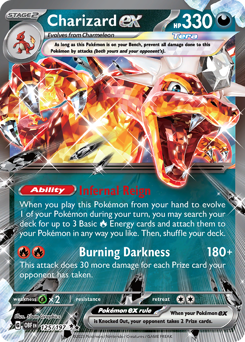
- Pokémon ex (lowercase again) — Scarlet & Violet era, 2023 onward. Two Prizes, and unlike V they can be Basic, Stage 1 or Stage 2.
- Mega Evolution Pokémon ex — the current Mega Evolution era, from September 2025. Three Prizes, and the flagship of the era being printed right now.
The three different "ex" cards (the big confusion)
This trips up almost everyone, and it costs people money when buying and selling. There are three separate things in the game's history whose names sound nearly identical. The original Pokémon ex, lowercase, ran 2003 to 2007. Pokémon-EX, uppercase and hyphenated, ran 2012 to 2016 and is a completely different mechanic on completely different-looking cards. And the modern Pokémon ex, lowercase again, arrived with Scarlet & Violet in 2023 and is what the game prints today. The official rules are blunt about it: 'Pokémon ex and Pokémon-EX are not the same.' The practical consequence is that a listing reading 'Charizard EX' is ambiguous without a set name, and the three eras carry wildly different prices. When you buy, sell or trade, name the set — not just the letters.
Pokémon-EX, Mega EX and BREAK (Black & White through XY, 2012–2016)
The uppercase Pokémon-EX era is the one modern collectors skip past most often, and it holds a lot of the game's best-looking cards. Pokémon-EX were two-Prize Basics with full-art versions that established the layout the game still uses. M Pokémon-EX were the era's Mega Evolutions, and their rules are worth knowing because they are so different from today's Megas: you evolved an M Pokémon-EX from a Basic Pokémon-EX of the same species, and doing so ended your turn immediately — a real cost, which the game later softened with species-specific Spirit Link Tools that prevented the turn from ending. They still gave up only two Prizes. Pokémon BREAK sat alongside them as an oddity: the card stacked sideways on top of the Pokémon below it, keeping that Pokémon's attacks and Abilities while adding its own, and it stayed a one-Prize card. Nothing since has looked quite like a BREAK, which is part of why they remain a fun thing to collect.
GX (Sun & Moon, 2016–2019)
Pokémon-GX are two-Prize cards from the Sun & Moon era, each carrying a single powerful GX attack you can use only once per game — a resource you spend rather than a move you repeat. This era is a collector favourite for reasons that have little to do with play. It introduced Rainbow Rares, the pastel-textured secret rares that defined the look of the period, alongside gold cards, and it produced Tag Team GX, which put two Pokémon on a single card and gave up three Prizes when Knocked Out. Tag Team alternate arts are among the most collected cards of the era. GX was discontinued when Sword & Shield arrived, so every GX card belongs to a closed three-year window, which is exactly the kind of boundary that makes a set-completion project appealing.
V, VMAX & VSTAR (Sword & Shield, 2019–2022)
The Sword & Shield era ran three tiers built on one base. Pokémon V are the powerful baseline: always Basic, always two Prizes. Pokémon VMAX evolve from a V into a giant Dynamax or Gigantamax form with enormous HP, often 300 or more, and they are the exception that gives up three Prizes when Knocked Out. Pokémon VSTAR also evolve from a V, give up two Prizes rather than three, and carry a unique VSTAR Power usable once per game; you can spot them instantly by their pearlescent white-and-gold border. This era produced many of the most valuable modern cards, the Umbreon VMAX alternate art from Evolving Skies — the card collectors call Moonbreon — being the most famous example. The era also gave us Radiant Pokémon, shiny one-Prize Basics limited to one per deck, which are worth knowing about because their unusual look leads people to assume they are rarer than they are.
ex again, and Tera ex (Scarlet & Violet, 2023–2025)
Scarlet & Violet brought back the lowercase 'ex'. These function much like the old V cards — premium two-Prize Pokémon — with one structural difference that matters: where every V was a Basic, an ex can be a Basic, a Stage 1 or a Stage 2 evolution, which put chase cards on evolution lines that had been shut out of the premium treatment for years. The standard versions carry the Double Rare symbol, two black stars, and the full-card alternate arts are Special Illustration Rares. Tera Pokémon ex are the era's sub-type, introduced in Paldea Evolved in 2023 and easy to identify by their crystalline artwork, where the Pokémon appears rendered in faceted gemstone. Their rule is a defensive one: a Tera Pokémon ex takes no damage from attacks while it is on the Bench. They still give up two Prizes. Regular ex cards are still printed today alongside the Mega Evolution cards, so 'ex' is the one suffix on this page that never went away.
Mega Evolution ex — what you are pulling right now
The current era, which opened with the Mega Evolution expansion in September 2025, brought Mega Evolution back to the game in a form that shares almost nothing with the XY version beyond the name. A Mega Evolution Pokémon ex gives up three Prize cards when Knocked Out rather than the two a regular ex costs, which makes it the heaviest bet in the modern game. But it is played the same way as a regular Pokémon ex: Basic, Stage 1 or Stage 2 depending on the species, no separate evolution step onto a Basic ex, no turn-ending penalty, and no Spirit Link Tools required. That is the fundamental difference from the XY-era M Pokémon-EX, and it is the thing people get wrong when they assume the two mechanics work alike. Identifying one takes a second: the card name prints in yellow text with black outlines, the ex symbol is in black lettering, and a rainbow-coloured banner below the HP reads 'The Mega-Evolved form of' the base Pokémon. On the collecting side, these carry the era's new top rarity — Mega Hyper Rare, a gold star on a black border — of which there are usually only one or two per set. The Ascended Heroes expansion in January 2026 added Mega Attack Rare on top of that, a full-art secret treatment showing a Mega Evolution ex with its headline attack in large foreign-language text, marked by two pastel stars in pink and green.
What it means for collectors
You do not need to play a single game to get value from all this. Three things follow directly. First, the suffix dates the card, which tells you roughly what it should cost and which other cards share its binder page — an era-sorted binder is one of the most satisfying ways to organise a modern collection. Second, the suffix flags a premium card worth checking rather than filing to bulk, because the special art treatments live almost entirely on these mechanics. Third, and most useful: within any mechanic, the plain version and the alternate-art version are different cards at different prices, often by an order of magnitude. A standard Double Rare ex might be a few dollars while its Special Illustration Rare is the chase card of the set. Pair the suffix with the rarity symbol to size up a card in seconds, and check the actual price before you get excited or disappointed.